Your chatbot can't forecast: why large quantitative models fill the gap
A partner of ours was recently building a pitch for a major entertainment venue in New York. The brief was big: draw visitors from across the tri-state area and prove the campaign worked.
So they did what everyone does now. They opened an AI chatbot and started building the plan.
And honestly, the chatbot was great. It organized the thinking, drafted the strategy and made the whole thing sound sharp.
Then they hit a wall. The plan needed answers the chatbot didn't have. Which audiences actually show up at venues like this? When do they come, from where, and how many of them are there? And once the campaign runs, how do you know whether it moved anyone through the door?
To me, this isn't a writing problem, it’s a numbers problem.
I've heard some version of this story on a lot of calls lately. A friend who runs an agency for home-services contractors ran into the same thing. AI could write him a beautiful plan, but it couldn't tell him which audiences were most likely to turn into leads.
That gap is what this series is about.
Key takeaways
- Large language models (LLMs) are built for words. Most business decisions run on numbers: transactions, foot traffic, pricing and inventory.
- A large quantitative model (LQM) is AI trained on numerical data to find relationships across signals and forecast what happens next.
- The strongest setups use both: the LLM as the interface, the LQM as the engine.
I've seen this movie before
I spent 2009 to 2016 in programmatic advertising. Back then, a lot of publishers were nervous about selling through exchanges. It was new, it was unfamiliar, and nobody had a clean comparison for it. A few years later, those same publishers were running their businesses on it.
This moment feels similar. When people first hear what we do at Intuizi, they reach for a comparison. Is it a Snowflake? A Palantir? An Omniture? Honestly, there's a little of each in our DNA. Like Snowflake, we're built for data at massive scale. Like Palantir, the point is turning that data into decisions. And the way Omniture made the web measurable, we measure real-world outcomes. But put those pieces together and you get something that didn't exist before. That's what makes it exciting, and it's also why there's a market to educate before anyone can buy it. That's what this blog series is for.
Credit where it's due
Let me be clear, I think large language models are incredible. They summarize, draft, brainstorm and answer questions about documents faster than any of us can. Like most people, I use them every day.
But they were built for words and most business decisions don't run on words.
Why LLMs are bad at math
The decisions that move revenue run on transactions, foot traffic, pricing, inventory and event logs. That means rows and columns, not paragraphs.
Here's the part that surprised me. You'd assume the problem is that language models read numbers like words. Researchers tested exactly that and it isn't the answer.
A research paper published in August 2026 ran a frontier LLM through controlled experiments on 31 benchmark datasets. The researchers ruled out the usual suspects, including how the model reads numbers and how the table is formatted. What they found instead: the wider the table, the worse the LLM does.
Think about what that means for a business. Real decisions don't run on two-column spreadsheets. They run on many signals at once: time, location, price, weather, local events. That's exactly where a language model starts to slip.
The researchers are careful to say they haven't pinned down why this happens inside the model. But the pattern explains why LLMs, brilliant at so many other tasks, keep losing on tables to statistical methods that are decades old. The market has noticed too. IEEE Spectrum has covered an entirely new class of AI models built for structured data, and SAP is investing more than €1 billion in the space.
When that much money and research goes after one gap, the gap is real.
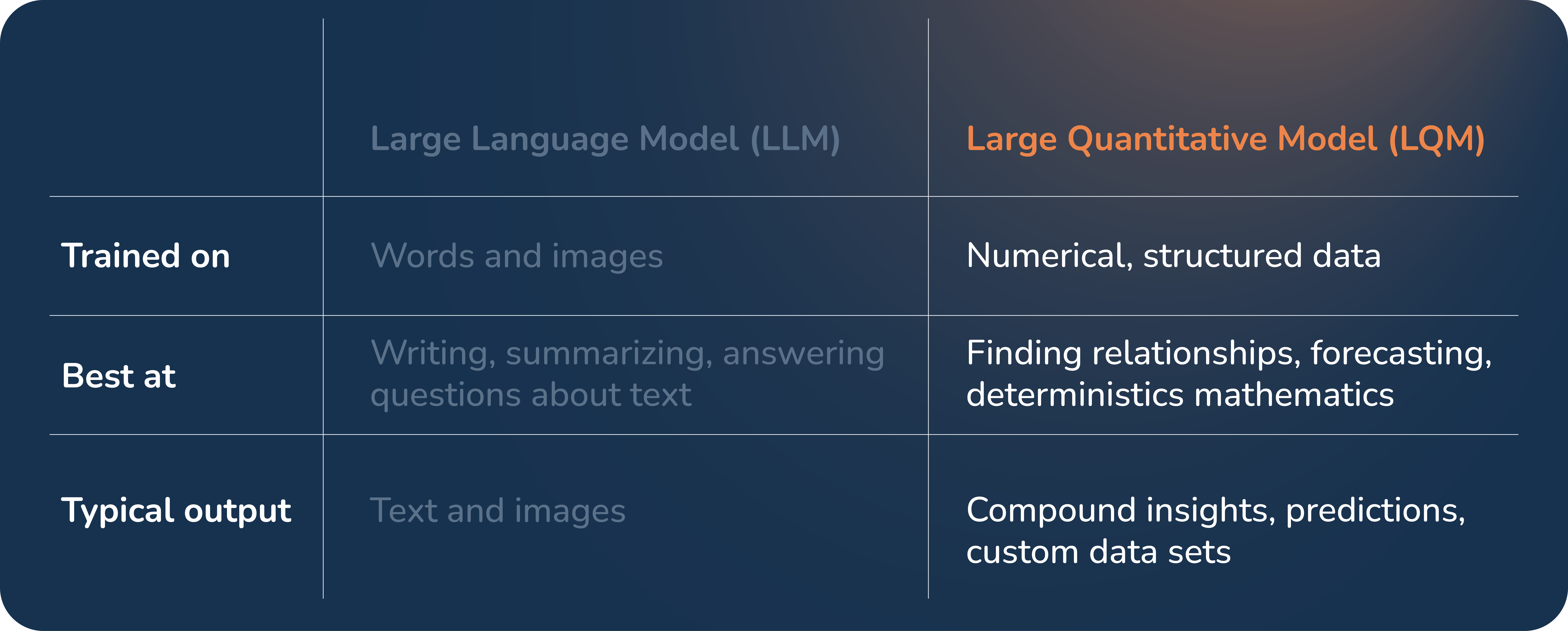
LLM vs. LQM: the short version:
The coach at the timeout
Here’s how I think about it.
Thirty seconds left, and the team is down by two points. There is one timeout left. Every coach knows this moment, and if you’ve ever run a business, you know it too.
In that huddle, three things are happening in the coach’s head at once.
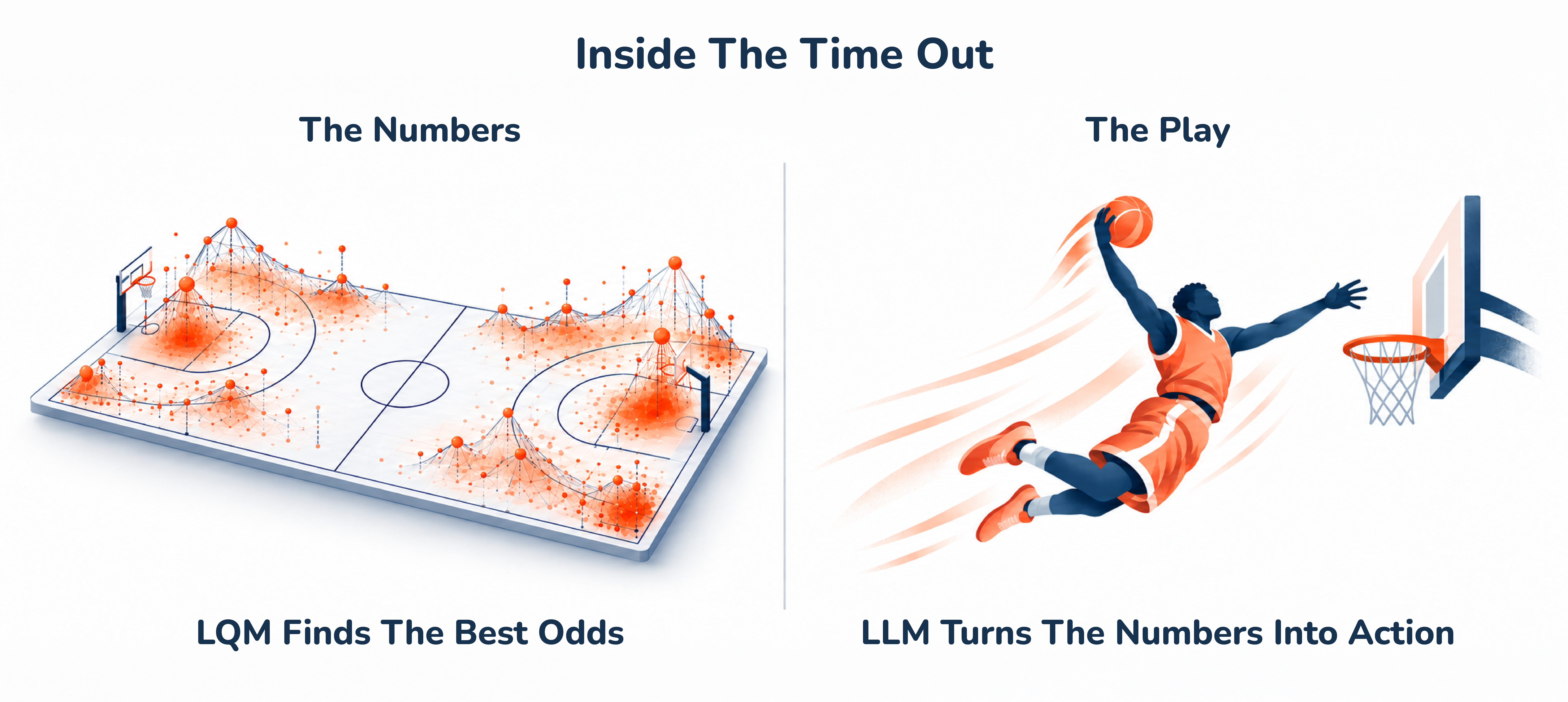
The numbers. Which shot has the best odds against this defense? Who’s been hitting from the corner tonight? That’s not a gut call. It’s data, and it’s the reason the whole league started shooting more three-pointers.
The translation. Numbers don’t win games, players do. The coach has to turn what the data says into a play that five tired people can understand and run in thirty seconds.
The gut. Who’s hot? Who’s rattled? What does this moment call for? No model replaces that, and it shouldn’t.
That’s how AI works in business, too. The LQM is the numbers. The LLM is the translation, turning those numbers into something your team can act on. And the call? That’s still yours.
AI won’t make the call for you. It makes sure your instinct is working from the right numbers, explained in a way your team can act on.
How an LQM turns data into decisions
A Large Quantitative Model is AI trained on numerical data rather than words. Instead of generating text, it finds the relationships between different types of data, uncovers patterns, and can perform mathematical operations with ease and great accuracy, and even make forecasts about what's likely to happen next.
Here's why that matters. Most companies are sitting on far more data than they use. The value isn't the data alone. It's the deep insight locked inside it, and how directly those insights connect to the decisions you make every week, whether that's inventory, operations, pricing, sales or marketing.
An LQM makes those connections. And increasingly, companies are realizing that the data they already have is their moat. More on this in Part 4 of our blog series!
Let’s go back to the entertainment venue campaign. With Intuizi's Large Behavioral Model, our flagship LQM, that partner could work from a multitude of behavioral signals to produce powerful datasets: which kinds of audiences visit comparable venues, from where, and when. Then they could reach those audiences and measure the results against real-world outcomes driven by the LQM, not just impressions. The chatbot wrote the plan, and the LQM gave it something to stand on.
How LLMs and LQMs work together
This isn't a story about one model replacing another. Honestly, the most exciting part is what happens when you put them together.
On its own, an LQM is powerful, but it speaks in numbers. On its own, an LLM speaks your language, but it's guessing on the math. Layer the language model on top of the quantitative model and things change: anyone on your team can ask a hard business question in plain English and get an answer grounded in real data.
Picture the entertainment venue example again. Instead of asking a chatbot to imagine who might show up, they ask: "Which neighborhoods sent the most visitors to venues like ours last summer, and how did that change on game nights?" The LLM understands the question and the LQM quickly and accurately does the math across de-identified behavioral signals. Then the LLM explains the answer in a way you can take straight into the pitch meeting.
That's the shift. You no longer have to choose between AI that's easy to talk to and AI that's grounded in your numbers. You can get both.
Back to the huddle: the coach gets the odds and the play in the same thirty seconds, and still makes the call.
In Part 2 of this blog series, we'll open the hood on the engine side and walk through how an LQM actually turns billions of raw signals into a vector space that drives unique insights and actions.
Want the one-page version?
If you're new to LQMs, start with our explainer: what they are, how they compare to LLMs, and what businesses use them for.